
Admin Onboarding - Item Workspace - Right Bar: Point Estimates
Step 7e of admin onboarding — what effort points are for, how to turn them on per item type (Decimal, Integer, Fixed List, or Disabled), and where they show on the item.
On this page
Effort points are a relative size the team agrees on, not hours. A "5" means more than a "3" for the same team; it means nothing compared with another team's "5". They are most useful before you know who will do the work, and they power velocity and capacity reports. If your teams estimate in hours instead, disable points and use Time Estimates.
Points versus time
Points are relative to the team; time is absolute. A senior engineer finishes an "8" faster than a junior does, yet the item is still an "8" because it is the same amount of work. When you know the person, time estimates become the sharper tool; many teams use points on Stories and time on Tasks.
Turn points on per item type#
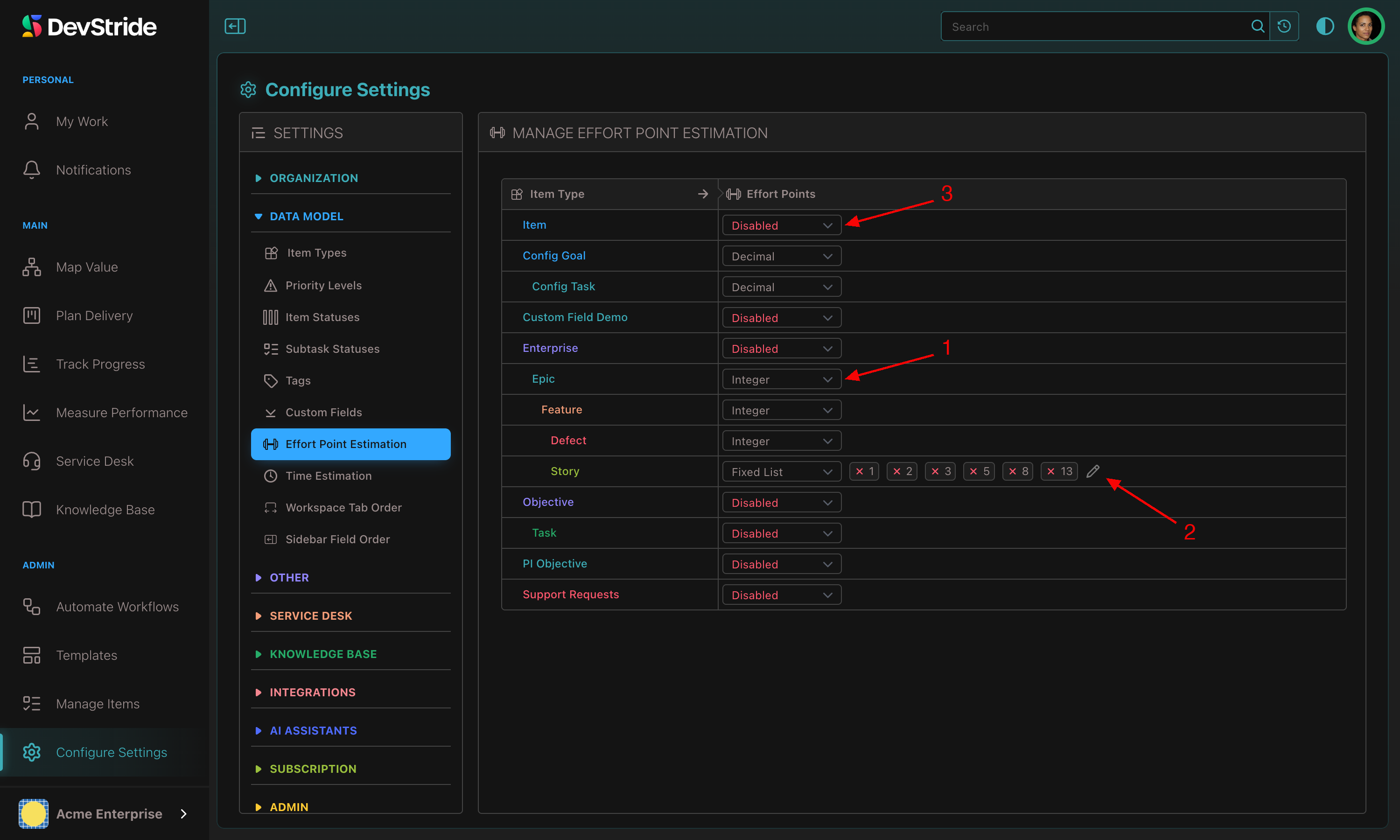
Open Configure Settings → Data Model → Effort Point Estimation. Each item type has one dropdown under Effort Points:
| Option | Meaning |
|---|---|
| Decimal | Any number, decimals allowed |
| Integer | Whole numbers only |
| Fixed List | Only the values you enter, comma-separated (a Fibonacci list: 1, 2, 3, 5, 8, 13) |
| Disabled | No point estimate on this type |
Most organizations enable points on the level the team commits to (Stories) and disable them on higher levels, where the roll-up of children does the job.
On the item#
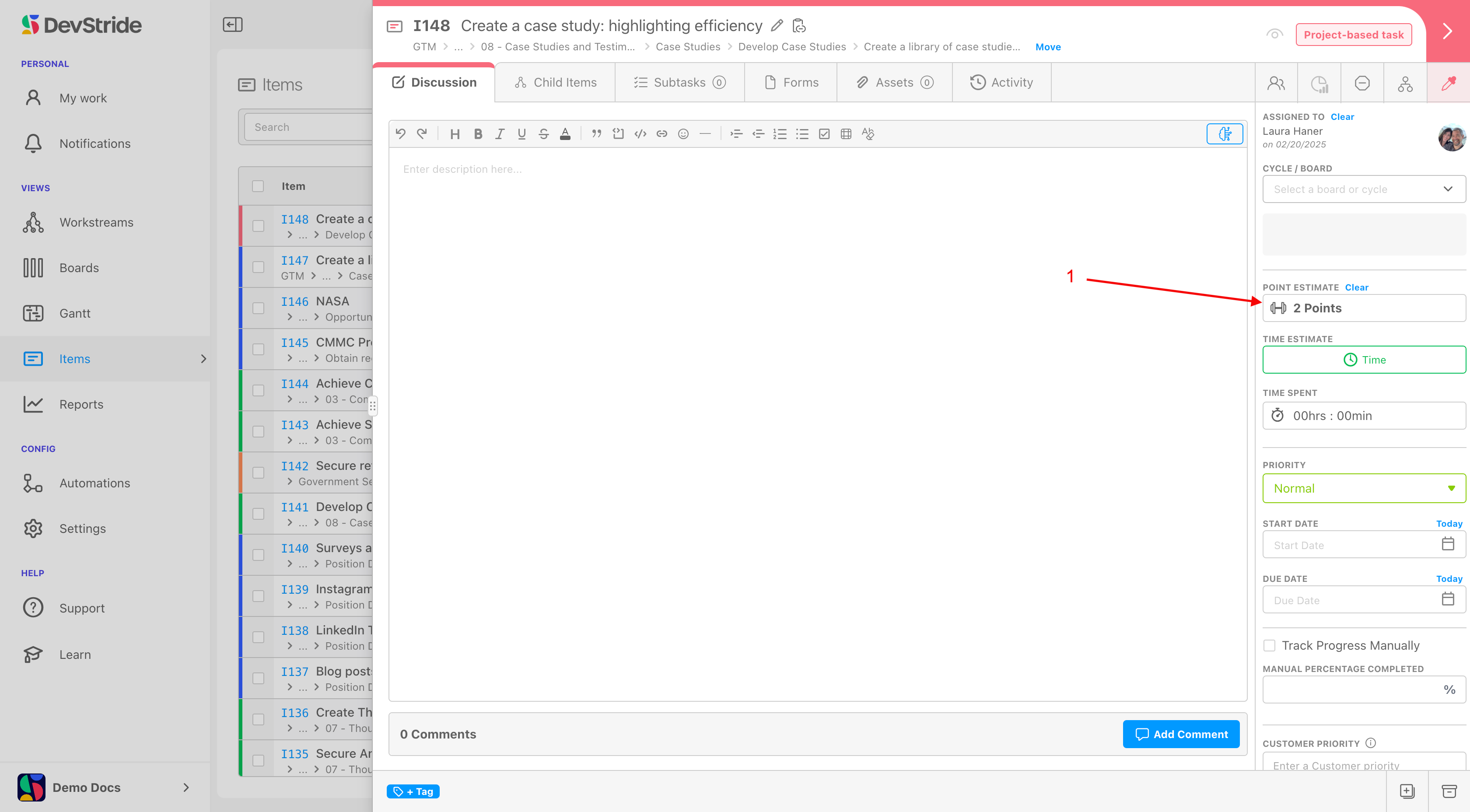
The Point Estimate field shows N Points or No estimate; click it to enter a value from the type's scale, or Clear. Parents show the roll-up of their children and warn when child estimates exceed the parent's own (Child estimates are greater than parent). If the type is disabled it says so. Points appear in filters, tables, boards, and the Velocity and Burn reports.
Next: Time Estimates.